
Today, two years have passed since I, along twelve other Griffith Business student leaders, two wonderful Griffith staff members, stepped on a plane headed for what can only be described as unimaginable adventures. We were headed to the rural areas of Laos, to the Seung River Valley districted, to complete a community development project. I thought I was ready for whatever would come my way and that I knew what to expect but I very quickly realised that there were plenty of lessons to be learned from our trip. The trip came at the back of what was an extremely difficult semester for me, I had stretched myself further than ever before and was at the point of exhaustion when we left Australia. However there was no time to sleep as whole new country was waiting to be discovered. We landed in Luang Prabang where we spent the day checking out the sights before heading to one of the eleven villages in the Seung River Valley about 2 hours Lao time (5 hours anywhere else in the world) from Luang Prabang. We spent our first days there staying with families in the area, sitting in meetings with community representatives and visit public services such as hospitals and schools, all to establish a need analysis for the community. This need analysis was then used towards deciding and prioritising future volunteering projects in the area.
After our stay in Seung River Valley, we ventured into the jungles not far from Vieng Thong where the Wildlife Conservation Society (WCS) is located. We learned about wildlife conservation and in particular the efforts they have taken to ensure the future of the Southeast Asian Tigers, we also got the chance to develop games to highlight the importance of wildlife conservation, and then we got to play those games with local children at Xonkhua Village School. For every individual staying in the area and for each animal sighted a certain amount goes to a community fund, which is then equally divided up among local farmers, this fund is designed to help locals refraining from killing the wildlife in the region for food, as the more animals are sighted by tourists the more money will go into the community fund and thus more money to each farmer.
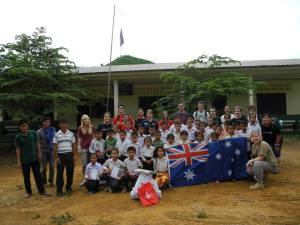
This entire journey was an unbelievable experience and brought with it some valuable lessons. Here are my top 8 lessons (some bigger than others) that I learned during my stay in Laos:
Although wanting to help others through volunteering is a great thing it is not always the right thing to do
Why do many people chose to give money to charity or even volunteer? We help out others in need, donate our time and money because it make us feel good about ourselves deep down. I am guilty of this myself, and it is ok as it is incredible hard to do anything in this world with purely altruistic motives. It is ok as long as we also constantly keep reminding ourselves that what we do, when we do decided to donate our time and money, does impact the life of others. Doesn´t it make sense then, that we collaborate with those we intend to help to see whether they want the help we are prepared to give or actually need help? Maybe what we think can be helpful to them can become quite the opposite and in fact deter their progress. When we impose our ways on to a local community the change is often neither permanent nor sustainable. During our visit to Sop Jak High School, we were told that an American group of students had been there couple of years prior to us, to install electricity in the school buildings. However the class rooms were still pitch dark, as the locals did not have the money to buy new lightbulb when they needed to be renewed as well as they did not have the know-how to maintain the wiring.
Furthermore it is important that local authorities take responsibility and regulate charity work conducted in their district. Cambodia is a clear example of charity work gone bad. The rise in foreigners wanting to help out at orphanages in Cambodia has created so-called orphanage tourism. And such is the demand for volunteer positions that locals have resorted to “borrowing” local children (children who live happily with their parents in a nearby town) to fill these orphanages of children in “need” for weeks at a time all in the name of charity work.
Now I am not saying you should not go out and volunteer. Wanting to help others is an admirable notion and should be commended. All I ask, is that you do a little research before heading off to your next volunteering project.
What else can be done?
Start by listening to the local residents and allow them to make up their own minds of what will benefit their community the best. Teach them to help themselves, instead of installing electricity for them, why not pay for an electrician from a nearby town to teach them how to install and maintain the electricity, this way the knowledge could then be passed down generation instead of becoming lost as soon as the volunteering group leaves. It further instils pride in the community and gives them ownership over the project and they will be much more likely to want to maintain it after the group leaves.
We are all the same
Despite our differing circumstances and where on this earth we were born we all share similar hopes and dreams for our future and our kids. The moments where we were able to understand each other despite big language barriers were quite beautiful, as some forms of communication truly transcends all nationalities.
Owning a cow is like having money in the bank.
This one was quite surprising to me but the more I think about it the more sense it makes. Cows are tangible valuables to the farmers and can always be sold to raise much needed funds. The families that own cows can usually afford to send their children to school. In the village we stayed in cows were sometimes donated by charities or organisations to the local residents. To ensure as many families would benefit from these donations, a cow was given to a family where it was made to procreate, once it had carried the calve to term the family would keep the calve and the cow would be passed along to the next family (poor cow!).
In some places wealth is measured in toilets
The wealthy families in the village all had one thing in common and that was a toilet in the house, and by toilet I mean a porcelain squat toilet with a bucket of water next to it to be used for flushing. The showers also consisted of big water containers and scoops, I´ll leave the rest to your imagination. I also learned that I tough through almost any situation and I really did not mind the toilet arrangements (for a short period of time at least.).
In Laos, time is arbitrary.
Someone gives you an estimate of two hours to your destination; expect to spend at least five hours tossing around at the back of the car on uncomfortable roads. And by all means do not expect that 5 hour drive to take any less than 11 hours. Bring lots of entertainment!
I can sleep anytime and anywhere.
I have been acquainted with this talent of mine before but nothing in comparison to what I experienced in Laos. Due to my mental and physical exhaustion I managed to sleep on a plane through severe turbulence, turbulence so severe it left some of my fellow travellers quite worried, at the back of a truck, on uncomfortable buses and to be honest I managed to fall asleep anywhere I could tilt my head back for a rest.
A bridge can disappear in the matter of a week.
On our first day in Luang Prabang we walked passed a bamboo bridge leading customers over to a restaurant on the other side of the river. When we came back from Seung River Valley and intended on dining at said restaurant the bridge was gone. It had been taken by strong currents in the river. It not only reminds me of how fleeting life can be but the bridge also serves as a reminder of the perseverance of the locals, I am sure that was not the first time the river swallowed the bridge and it probably wasn´t the last time either and yet it will be built again, and again and again.
Bartering can be fun, but there is a time and place for it.
In most of the Asian countries I have been to bartering is normal occurrence, at one occasion I even got told the locals would be insulted if I did not attempt to barter for a better price. I will be the first one to admit that bartering can be a lot of fun. It can be quite exhilarating knowing that you have managed to negotiate a lower price for the product you have been eyeing out. But there is a limit to everything, sometimes we need to take a step back and ask ourselves whether it is really worth it to us to purchase the product for $1 less just for the fun of it knowing that the salesman might be losing out on a big chunk of not only their profit margin but their only mean to feed and house their family. To many of us a dollar means very little but to the locals it just might mean the difference of being able to eat that day.
 Elisabet Osk